
If you were looking for a Organs During 10 Hours of Fasting. Than you’re search ends here. Due to its possible health benefits, fasting has grown in popularity, particularly when done in ways like intermittent fasting. Ten hours is a typical fasting window, which usually happens spontaneously overnight when you stop eating after dinner and wait until breakfast. But what does your body really go through at this time? When you go ten hours without eating, how do your organs react?
Let’s examine the effects of a 10-hour fast on your main organs and how this affects your general health. Hours 12, your liver just ran out of sugar.
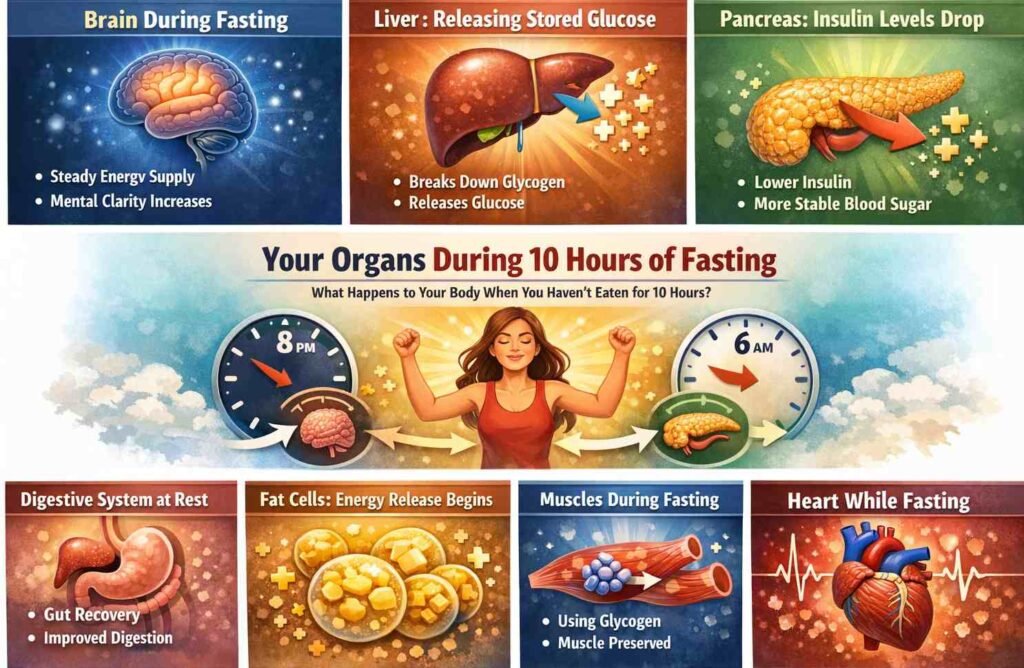
Recognizing the 10-Hour Window for Fasting
A 10-hour fast typically takes place when:
- Around eight o’clock at night, you finish dinner.
- Don’t eat late-night snacks
- Around six in the morning, have breakfast.
Significant metabolic alterations are triggered even during this brief time of moderate fasting. Your body switches from using stored energy to processing recent meal intake.
Is a 10-Hour Fast Sufficient for Losing Fat? -Organs During 10 Hours of Fasting
While a 10-hour fast by itself might not result in significant weight loss, it can:
- Avoid overindulging in food
- Cut back on pointless snacking
- Encourage improved metabolic health
- If desired, act as a basis for lengthier fasting windows.
Who Needs to Use Caution?
Fasting might not be the best option for:
- Women who are nursing or pregnant
- Individuals with blood sugar imbalances or diabetes
- People who suffer from eating disorders
- Individuals taking specific drugs
Hours 18, your brain is now eating itself for fuel. Hour 24, your cells are literally cannibalizing their own damaged parts to survive. And by hour 10, your body has become a fat burning disease fighting machine that big pharma doesn’t want you to know about. This is what happens inside your body during a 10 hours fast. And trust me, your organs were not ready for this. Look, I’m not here to tell you fasting is some magic cure all. But what I am going to show you is what actually happens minute by minute, organ by organ, when you stop eating for 10 hours.
And according to a landmark study published in cell Metabolism, the metabolic switch that flips during extended fasting triggers cellular changes that most people never experience in their entire lives. So, buckle up because we’re about to take a journey through your body that’s equal parts fascinating and slightly horrifying. All right, hours 1 to 4. You’ve just finished your last meal. Your stomach is a bustling factory, breaking down that burger or salad into glucose, your body’s premium fuel. Your pancreas is pumping out insulin like a bartender at happy hour, telling your cells, “Drink up. Energy is on the house.” But here’s where it gets interesting. Hour six, your insulin levels start dropping.
Your body has burned through the easy glucose in your bloodstream. Think of it like this. You’ve been running your house on the electricity from the grid, but now the power company just shut off. Time to switch to the backup generator. Hour 8 to 12. Your liver, this absolute legend of an organ, steps up. It’s been storing glucose as glycogen, basically emergency fuel packs. A 2019 study in Nature Metabolism found that the average person stores about 100 gram of glycogen in the liver. That’s roughly 400 calories, enough to keep you going for not very long. Your liver is now like a warehouse during black Friday, frantically unloading every box of glycogen it has.
But here’s the kicker. By hour 12, those shelves are getting empty. And that’s when your body realizes, “Oh no, we might actually be in trouble here.” Hour 12 to 16. This is where the magic and the madness begins. Your glycogen stores are depleted. Your body is now staring into the abyss asking, “What do we burn now?” And the answer is fat.