
If you were looking for a Body fights weight loss. Than you’re search ends here.
Your body is evolutionarily conditioned to gain weight, which means that your body is also evolutionarily conditioned not to lose weight and definitely not to keep weight off. According to one explanation called “the thrifty gene hypothesis,” when we were hunter gatherers, our body’s powerful anti-starvation responses helped us survive. We had to find our couldn’t, so our bodies stored calories to keep us alive. The better we stored calories, the better our chance of survival.
What changed?
Nowadays, if we can afford food, there’s plenty of it, everywhere. We don’t have to hunt. Even the gathering is easy. We can order food to be delivered directly to our sofa, and portions are huge compared to even 20 years ago. And a lot of food is tasty, but not so great for us. We’re living in what obesity doctors like me call an obesogenic environment: limited need for any kind of physical activity, and easy access to inexpensive, calorie-rich, nutrient-poor food or food-like substances. Our bodies, primed to keep us alive, have gone into overdrive to store all these calories from all of that food, just in case.
And this is one of the reasons why we have an obesity epidemic in the United States, where 42 percent of adults have obesity, and when we take a look at overweight and obesity combined that number goes up to 74 percent. Let’s go back to the biology part of the equation because it gets worse. For example, a high-fat diet damages nerve cells in the area of our brain called the hypothalamus, which is like a thermostat, regulating how hungry we are and how we use energy.
When these nerve cells or neurons become inflamed, feedback signals from our guts, our digestive system, and our fat cells can’t get through to our brain to tell us to stop eating when we’re full, and to stop storing calories when we’re not at risk of starvation. It literally becomes harder to tell how full we are after eating, and how much fat our bodies really need to keep us alive. Without an accurate thermostat sensor, our bodies store more calories as fat, and we’re more prone to what we call food noise or persistent thoughts of food, often leading to maladaptive eating behavior. And this is how weight gain leads to weight gain. It’s a vicious cycle.
And there are other factors that compound the situation. Some people are even more genetically susceptible to obesity or develop health complications like sleep apnea that can worsen obesity and other health outcomes. Many people have even less access and ability to afford healthy food, and medications can be a huge culprit, with so many common prescriptions and over the counter drugs that are weight promoting. And people with obesity are extremely, likely to experience weight bias, stigma and discrimination, which can worsen obesity. And I can go on and on about factors other than eating too much can exercising too little that lead to weight gain.
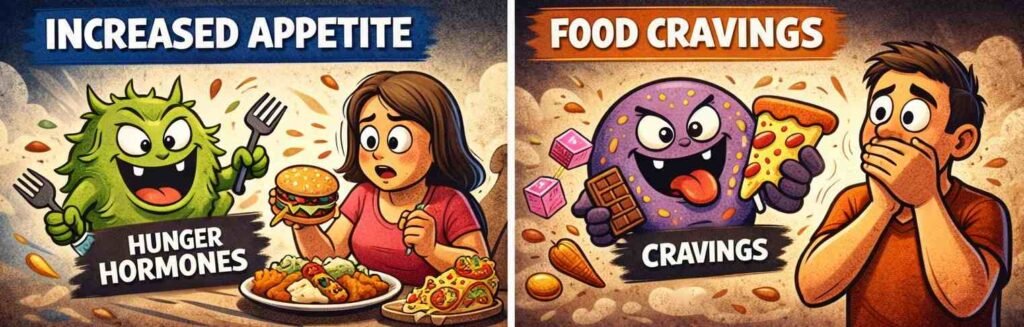
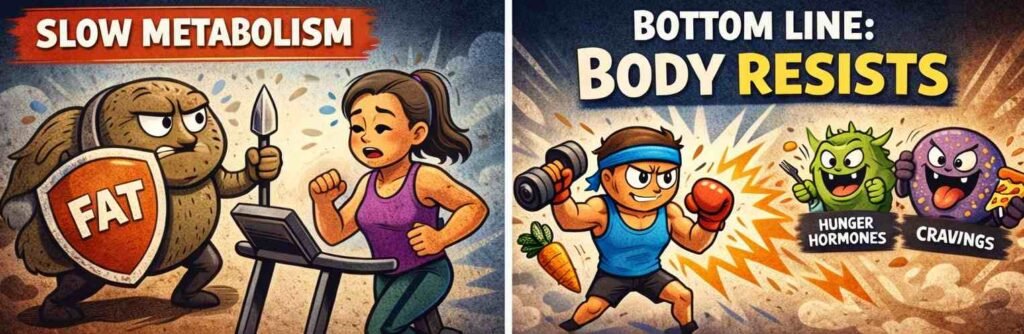
When people with obesity try to lose weight, their bodies freak our and think they’re staring. The hunger hormone, ghrelin, increases and the fullness hormones decrease. It’s not your imagination. Every time you diet, your body holds on to calories. Your metabolic rate slows down and your bodies behave as if you’re starving. This metabolic adaptation if, say, you find yourself on a deserted island with nothing but papaya and tree bark to eat. But if your coworker has a bottomless candy bowl, it makes life rough.